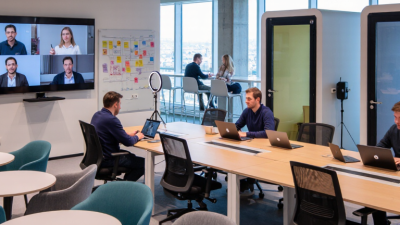
| Hybrid and Activity-Based Workplaces |
Workplace attendance pattern |
Many knowledge-work teams operate with approximately 2–3 remote-work days per week, depending on role and geography. |
Design for 60–75% peak desk utilization rather than one permanent desk per employee. |
Desk-booking platforms, occupancy sensors, room scheduling, flexible furniture |
Better space utilization and improved employee choice |
Buyer benchmark |
| Artificial Intelligence for Workplace Operations |
Automation coverage |
AI is increasingly used for service-desk support, meeting summaries, workplace search, and facilities alerts. |
Prioritize 3–5 high-volume workflows with measurable labor, response-time, or service-quality outcomes. |
Generative AI, enterprise search, workflow automation, natural-language interfaces |
Faster service delivery and lower administrative workload |
2026 planning estimate |
| Smart Building Energy Management |
Operational energy reduction |
Automated controls for heating, cooling, lighting, and ventilation commonly produce measurable savings when systems are properly commissioned. |
Target a 10–20% reduction in controllable building energy use against a verified baseline. |
Building-management systems, smart meters, demand controls, predictive analytics |
Lower operating cost and reduced carbon emissions |
Industry benchmark |
| Occupancy Intelligence and Space Optimization |
Space-use visibility |
Traditional planning often relies on badge counts, surveys, or manual observation, which can miss real-time utilization. |
Collect privacy-conscious utilization data for at least 8–12 weeks before major footprint decisions. |
Anonymous people counting, room sensors, heat maps, utilization dashboards |
More accurate leasing, relocation, and floor-plan decisions |
Procurement benchmark |
| Indoor Air Quality and Healthy Buildings |
Indoor environmental quality |
Carbon-dioxide concentration is widely used as a practical indicator of ventilation adequacy, although it is not a complete measure of air quality. |
Use continuous monitoring and investigate sustained readings above approximately 1,000 ppm, subject to local guidance. |
CO₂ sensors, particulate monitoring, demand-controlled ventilation, filtration |
Improved occupant comfort, health protection, and ventilation transparency |
Technical benchmark |
| Zero-Trust Workplace Connectivity |
Identity and device protection |
Distributed work increases the number of users, endpoints, applications, and locations that require secure access. |
Require phishing-resistant multi-factor authentication for privileged access and risk-based access for sensitive systems. |
Identity management, device posture checks, network segmentation, encrypted access |
Reduced unauthorized-access risk and stronger compliance control |
Security practice |
| Private 5G and Advanced Wireless Networks |
Operational connectivity |
Wireless networks are increasingly used for mobile devices, sensors, video, robotics, and location-aware services. |
Use dedicated or segmented wireless capacity where device density, reliability, or mobility exceeds conventional office requirements. |
Wi-Fi 6/7-class networks, private cellular, edge gateways, network analytics |
Higher device density, improved mobility, and more reliable applications |
2026 planning estimate |
| Digital Twins for Facilities |
Asset and maintenance visibility |
Many buildings still store floor plans, equipment records, work orders, and sensor data in separate systems. |
Connect priority assets representing the highest maintenance cost or operational risk before expanding to the full portfolio. |
Building information models, asset registries, IoT data, predictive maintenance |
Fewer unplanned failures and better lifecycle planning |
Implementation benchmark |
| Interoperable Smart Workplace Infrastructure |
System integration |
Closed or poorly documented interfaces can increase switching costs and make data consolidation difficult. |
Require documented APIs, exportable data, open integration methods, and clear data-ownership terms in every major purchase. |
Open APIs, common data models, identity federation, integration middleware |
Lower vendor lock-in and easier portfolio-wide scaling |
Procurement standard |
| Digital Employee Experience |
Service-performance measurement |
Employees increasingly expect workplace services to be as simple to access as consumer digital services. |
Track task completion rate, response time, adoption, satisfaction, and accessibility across major workplace services. |
Unified workplace applications, digital signage, service portals, mobile credentials |
Higher adoption and fewer friction points in daily work |
Measurement framework |
| Circular and Low-Carbon Workplace Procurement |
Product lifecycle impact |
Embodied carbon, repairability, reuse, and end-of-life treatment are becoming important purchasing considerations alongside price. |
Evaluate total cost of ownership, service life, repair options, recycled content, and end-of-life recovery in bid scoring. |
Lifecycle assessment, modular furniture, energy-efficient equipment, material passports |
Lower lifecycle cost, reduced waste, and stronger sustainability reporting |
Procurement practice |
| Resilient and Adaptive Workplace Infrastructure |
Business-continuity readiness |
Climate events, power disruptions, cyber incidents, and supply-chain interruptions can affect workplace availability. |
Maintain tested continuity procedures for power, connectivity, critical building systems, remote operations, and emergency communications. |
Backup power, redundant connectivity, remote monitoring, incident-management platforms |
Reduced downtime and faster recovery from operational disruptions |
Risk-management practice |
| Workplace Analytics with Privacy by Design |
Data-governance maturity |
Occupancy and employee-experience data can create privacy risks if collection purpose, retention, and access are not clearly defined. |
Use data minimization, aggregation, retention limits, role-based access, and transparent employee notices before deployment. |
Aggregated analytics, privacy controls, consent workflows, governance dashboards |
Useful insight with lower regulatory and reputational exposure |
Governance requirement |
| Outcome-Based Technology Investment |
Investment evaluation |
Technology projects are increasingly assessed by operational outcomes rather than hardware quantity or installation scope. |
Define baseline metrics and acceptance criteria for cost, energy, utilization, service quality, security, and employee experience. |
Performance dashboards, benefits tracking, service-level agreements, continuous commissioning |
More accountable spending and clearer return-on-investment decisions |
Buyer framework |