Choosing the right Film Faced Plywood is rarely as simple as selecting the darkest surface or the lowest price. Different projects demand different combinations of strength, water resistance, surface smoothness, and reusability. Concrete formwork may require a durable phenolic film, while vehicle floors often benefit from an embossed, anti-slip surface. The plywood core matters too. Birch provides strong, consistent layers, while eucalyptus and poplar can offer lighter weight and more competitive pricing. These differences affect panel stability, cutting performance, and the final quality of a concrete finish.
This guide examines the top types of Film Faced Plywood and explains where each option performs best. It considers brown and black film surfaces, smooth and textured finishes, hardwood and softwood cores, and edge-sealing treatments. Practical details matter. A well-sealed edge can reduce moisture entry after repeated cutting. A rough film may improve grip but leave a less refined appearance. Small choices matter.
On active construction sites, panels may face rain, vibration, cement residue, and repeated stripping. Product datasheets, formal test reports, and supplier quality records should support every technical claim. Standards and local project specifications also deserve careful review, because “waterproof” is often used too casually in marketing. No single type wins every application. That is the part many comparisons overlook. The best choice depends on the expected number of uses, load conditions, storage practices, and finishing requirements. Even experienced buyers can misjudge performance when they compare price alone.
What Are the Top Types of Film Faced Plywood?
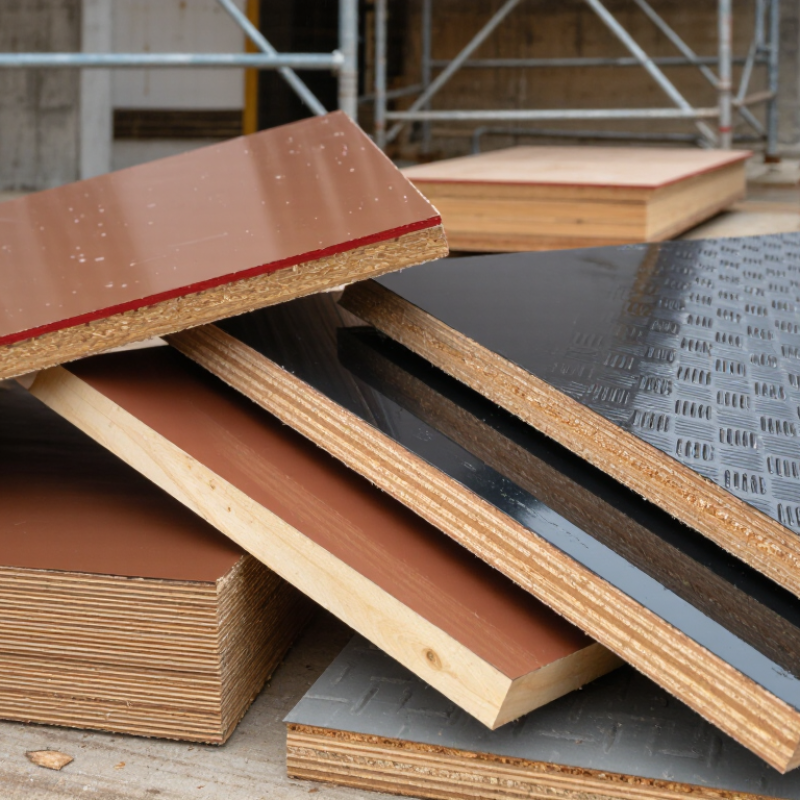
Film faced plywood is best defined by three features: core, coating, and performance. The core may use hardwood, softwood, poplar, eucalyptus, or mixed veneers. Hardwood cores usually provide stronger screw holding and better resistance to repeated loading. Softwood cores can reduce weight, but their strength varies between manufacturers. Poplar plywood is easy to handle and often costs less. However, it may require careful support beneath heavy concrete forms.
The coating also changes the panel’s working behavior. Smooth phenolic film creates a cleaner concrete surface and releases more easily after curing. Wire-textured film can improve grip on platforms and temporary walkways. Film weight matters, but it is not the only factor. A thick surface can still fail when the edges absorb water. Sealed edges are essential.
Performance depends on more than the product label. Check bending strength, thickness tolerance, water resistance, and the number of expected reuses. A stable panel should remain flat after wetting and drying. That sounds simple. It is not.
Site conditions often expose weak points first. Poorly supported sheets may bow, even with a durable coating. Rough handling can damage corners before the first use. Inspect the surface, edges, and core after each cycle. Reusing a panel without checking hidden delamination is a costly mistake. The best type is therefore project-specific, and selection may need revision after real site testing.
Phenolic-film plywood with hardwood or eucalyptus cores generally provides the strongest balance of water resistance, surface durability, and reuse potential. Birch cores offer high strength and dimensional stability, while poplar cores are lighter and more economical. The values shown are comparative performance indices from 1 to 5 based on typical characteristics of these plywood constructions; actual results vary with manufacturing quality, film weight, bonding, thickness, and job-site conditions.
Phenolic film faced plywood is often judged by its overlay weight, usually measured in grams per square metre. Common grades range from 120 to 240 g/m². The film is pressed onto the plywood surface under heat and pressure. This creates a smoother, more water-resistant face for concrete forming and other demanding work.
A 120–160 g/m² overlay suits lighter construction cycles and general interior forming. It can be practical when panels receive careful handling and limited moisture exposure. Grades around 180–220 g/m² provide a stronger balance between surface protection and cost. They are often selected for repeated concrete pours. The 240 g/m² grade offers a denser surface and improved resistance to abrasion, moisture, and cleaning. However, a heavier film does not automatically mean better plywood.
The core quality still matters. Poorly bonded veneers may swell, delaminate, or leave uneven concrete impressions. I have seen heavy film fail early when edges were unsealed or panels were dragged across rough ground. That mistake is easy to repeat. Check the core, glue line, film uniformity, and edge treatment before choosing a grade. Storage also affects performance; flat stacking in a dry, covered area helps prevent warping. In practice, 180–220 g/m² is often a sensible working range, but project cycles and handling methods should decide the final specification. More testing would be wise when reuse targets are unusually high.
Melamine-coated plywood is often selected for its smooth, cleanable surface. However, the coating does not determine the panel’s EN 314-2 bond class. The core veneers and adhesive system remain decisive.
EN 314-2 Class 1 suits dry interior applications, such as protected walls or temporary indoor partitions. Class 2 supports humid conditions, including covered areas with occasional moisture. Class 3 is intended for exterior exposure, where rain, repeated wetting, and drying can occur. These classes describe bonding quality, not complete weather resistance.
A panel may have a bright melamine face and still show weak edge bonding. Look for technical documents confirming EN 314 testing.
Check the panel edges for gaps, lifted veneers, or uneven glue lines. A simple inspection under strong light can reveal small separations.
The coating can improve release and surface protection. It cannot repair poor core construction. Cut edges also need suitable sealing in damp environments. This detail is easy to overlook.
In practice, panel thickness, veneer quality, pressing control, and storage conditions affect performance. Store sheets flat and raised from wet floors. Do not assume Class 3 makes every application safe. Long exposure, standing water, or poor support may still cause swelling.
One practical limitation remains. EN 314-2 bond class testing does not replace project-specific structural checks. Load, span, fasteners, and local climate still matter. A glossy surface looks convincing, but appearance alone proves very little.
What Are the Top Types of Film Faced Plywood?
Film faced plywood includes phenolic-film, melamine-film, and PP-faced panels. PP-faced plywood deserves special attention for repeated concrete formwork cycles. FAO’s Global Forest Products Facts and Figures 2023 records global plywood production at approximately 170 million cubic metres in 2022. This scale reflects strong demand, but volume does not guarantee reliable reuse. Panel structure matters more than the surface label.
PP film creates a smooth, low-absorption face. Fresh concrete usually releases more cleanly from it. Water also has less opportunity to enter through the surface. However, the edges remain vulnerable. A cut edge can swell after repeated washing, especially when water stays beneath stacked sheets. The USDA Wood Handbook reports that wood reaches about 12% moisture content at 20°C and 65% relative humidity. That moisture movement can still affect the plywood core. Small edge gaps become visible on the next pour.
For repeated cycles, crews should inspect film scratches, corner crushing, bowing, and exposed veneer. A clean panel is not necessarily a sound panel. ACI 347R explains that formwork pressure depends on concrete temperature, placement rate, slump, and vibration. Therefore, one fixed reuse number is unreliable. Testing should examine bond quality, thickness swelling, water absorption, and bending retention under EN 314-2 and EN 636 requirements. In practice, dry storage and careful stripping may extend service life more than a thicker film. That is easy to underestimate. I would also question any cycle claim without test conditions, panel thickness, concrete mix, and repair records.
| Film-Faced Plywood Type | Surface Film | Typical Core Construction | Common Thicknesses | Approximate Reuse Potential* | Concrete Release and Finish | Moisture Resistance | Best-Fit Formwork Application |
|---|---|---|---|---|---|---|---|
| PP-Faced Plywood | Thermoplastic polypropylene sheet, commonly textured or embossed | Structural plywood core with sealed edges; core quality varies by construction grade | 12, 15, 18, 21, and 24 mm | Approximately 30–80 cycles with proper cleaning, storage, and edge sealing | Good release performance and a relatively consistent concrete surface; textured films may leave a controlled pattern | Very good; the plastic surface is resistant to water and many alkaline concrete residues | Repeated wall, slab, column, and tunnel formwork where surface durability and reduced film damage are priorities |
| Phenolic Film-Faced Plywood | Paper-based phenolic resin film, usually smooth on one or both faces | Multi-ply hardwood, softwood, or mixed-wood structural veneer core | 12, 15, 18, 21, and 24 mm | Approximately 10–30 cycles, depending on film weight, core quality, handling, and maintenance | Good release when correctly oiled; can provide a smooth concrete finish, but surface film may scratch or wear at edges | Good during normal formwork use; exposed cut edges require sealing to limit water ingress | General concrete walls, slabs, beams, and foundations with moderate reuse requirements |
| Melamine-Faced Plywood | Melamine-impregnated decorative or technical paper overlay | Stable plywood core, often selected for a smooth and uniform face | 12, 15, 18, and 21 mm | Approximately 5–15 cycles in concrete formwork, depending on grade and site conditions | Initially smooth, but the face can be more vulnerable to abrasion, impact, and alkaline exposure than polypropylene film | Moderate to good; damaged faces and unsealed edges can absorb moisture | Projects requiring a clean initial finish or light-to-moderate formwork reuse |
| Wire-Mesh or Wire-Faced Plywood | Phenolic film combined with a raised wire or mesh pattern | Heavy-duty structural plywood core, usually with sealed edges | 15, 18, 21, and 24 mm | Approximately 10–25 cycles when the patterned surface is kept intact | Provides a patterned concrete finish and improved slip resistance; not intended for a smooth architectural surface | Good, provided the film and edges remain undamaged | Platforms, decks, ramps, precast elements, and applications where traction or a textured finish is useful |
| High-Density Overlay Plywood | Resin-impregnated high-density overlay, usually smooth and durable | High-quality structural veneer core with a dense face overlay | 12, 15, 18, 21, and 24 mm | Approximately 20–50 cycles with careful handling and regular release-agent use | Very good potential for smooth concrete surfaces; face damage is usually concentrated at corners and cutouts | Good to very good; all cut edges and penetrations should be sealed | High-quality wall, slab, beam, and precast formwork requiring a durable smooth face |
| Standard Exterior Plywood with Coating | Paint, resin coating, or site-applied protective layer | Exterior-bonded plywood with variable veneer quality and construction | 12, 15, 18, and 21 mm | Approximately 3–10 cycles | Variable; surface defects, coating wear, and veneer telegraphing can affect the concrete finish | Moderate; performance depends heavily on coating quality and edge protection | Small projects, one-off pours, temporary formwork, and applications with limited reuse expectations |
*Reuse figures are practical industry ranges rather than guaranteed ratings. Actual cycle life depends on panel thickness, core integrity, concrete pressure, tie-hole layout, release-agent selection, cleaning methods, edge sealing, storage, and whether panels are stripped without prying or impact damage.
Film faced plywood is best ranked by core durability, not surface color. EN 636-1 suits dry interiors, while EN 636-2 targets humid conditions. EN 636-3 covers exterior exposure. The coating protects the face, but it cannot repair weak veneers or poor bonding.
High-density hardwood plywood usually ranks highest for repeated concrete-form use. Its stable core can tolerate pressure, moisture, and demoulding cycles. Combi-core plywood offers a practical middle position. It balances weight, bending strength, and surface stability. Poplar-core plywood is lighter and often less expensive, but its EN 636 classification must be checked carefully.
The USDA Forest Products Laboratory’s Wood Handbook reports that plywood performance depends strongly on veneer quality, moisture, and adhesive bonding. ASTM D1037 testing adds useful evidence through bending, water absorption, and thickness-swelling measurements. These results reveal weaknesses that a smooth film may hide.
Tips: Ask for the EN 636 class and full ASTM D1037 test report. Check 24-hour thickness swelling, bending strength, and bond quality. Do not rank panels by film thickness alone. A thicker film can still cover an unstable core. Field experience also matters. Some panels perform well in one project, then disappoint under repeated wetting. That detail deserves honest review.